Payfud
A multi-tenant restaurant CMS covering menus, reservations, loyalty, and marketing — built and led as tech lead turned co-founder.
Problem
Restaurant owners needed a way to manage menus, reservations, loyalty programs, and their online presence without stitching together a pile of disconnected tools built for larger chains.
Solution
Led a 3-person frontend team building a multi-tenant React dashboard and an SEO-heavy Next.js public-facing app, on top of a Python/Django backend. Designed the full design system in Tailwind and React from scratch, covering the admin panel, analytics, menu, and restaurant-facing interfaces.
3 people
Frontend team led
Multi-tenant
Architecture
Tech stack
Architecture
Two frontends shared one backend: a React admin dashboard where restaurant owners manage menus, reservations, and loyalty, and a separate SEO-heavy Next.js app for the public-facing restaurant pages guests actually land on from Google. Splitting them mattered — the admin panel could stay a client-rendered SPA optimized for interaction density, while the public app got server rendering and the metadata/performance work a restaurant’s organic search traffic actually depends on, without either app compromising for the other’s constraints.
Multi-tenancy lived at the data layer on the Django backend: every restaurant’s menus, hours, and branding were scoped by tenant, so one dashboard codebase served every restaurant on the platform instead of forking a codebase per client — the only way three frontend engineers could support an open-ended number of restaurants in a few months.
Design system first
Before either app had real features, I built the shared Tailwind/React component library both would consume — buttons, form fields, tables, the menu-builder primitives — so the admin panel and the public app looked like one product instead of two. That upfront cost paid off fast: new screens across the 3-person team composed from the same primitives instead of each engineer re-deriving spacing and color decisions per feature.
Leading under a hard deadline
Went from sole tech lead to co-founder partway through the build, which meant the technical roadmap now had to answer to the business roadmap directly instead of through a layer of product management. With three months and three engineers, the discipline was ruthless scope triage: menu management, reservations, and loyalty shipped first because they were the reasons a restaurant would switch tools at all; deeper analytics and marketing automation came after, once the core loop proved out with early restaurant partners.
Details
Owned both the technical and product side of the build — from architecture decisions down to aligning the UI pixel-for-pixel with Figma, while balancing what to build next against what would actually move the needle for restaurant owners on day one.
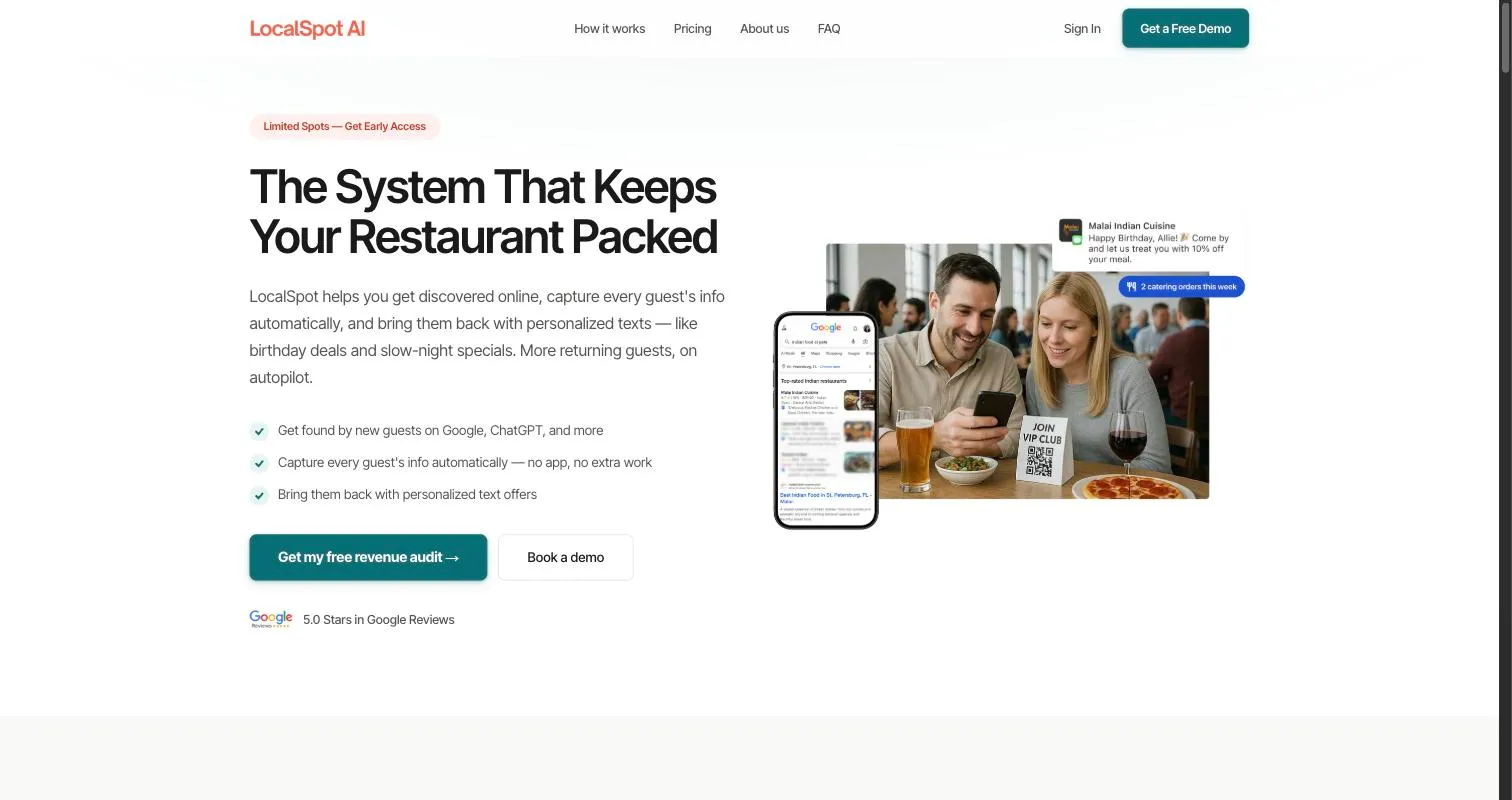
The product has since evolved past this build and rebranded to LocalSpot AI, now focused on restaurant marketing and guest retention rather than the original CMS scope — the live site today reflects that pivot, not the multi-tenant CMS described above.
